People's Court Daily Front Page:The Story Behind 40-plus Pages of Pages of Charts
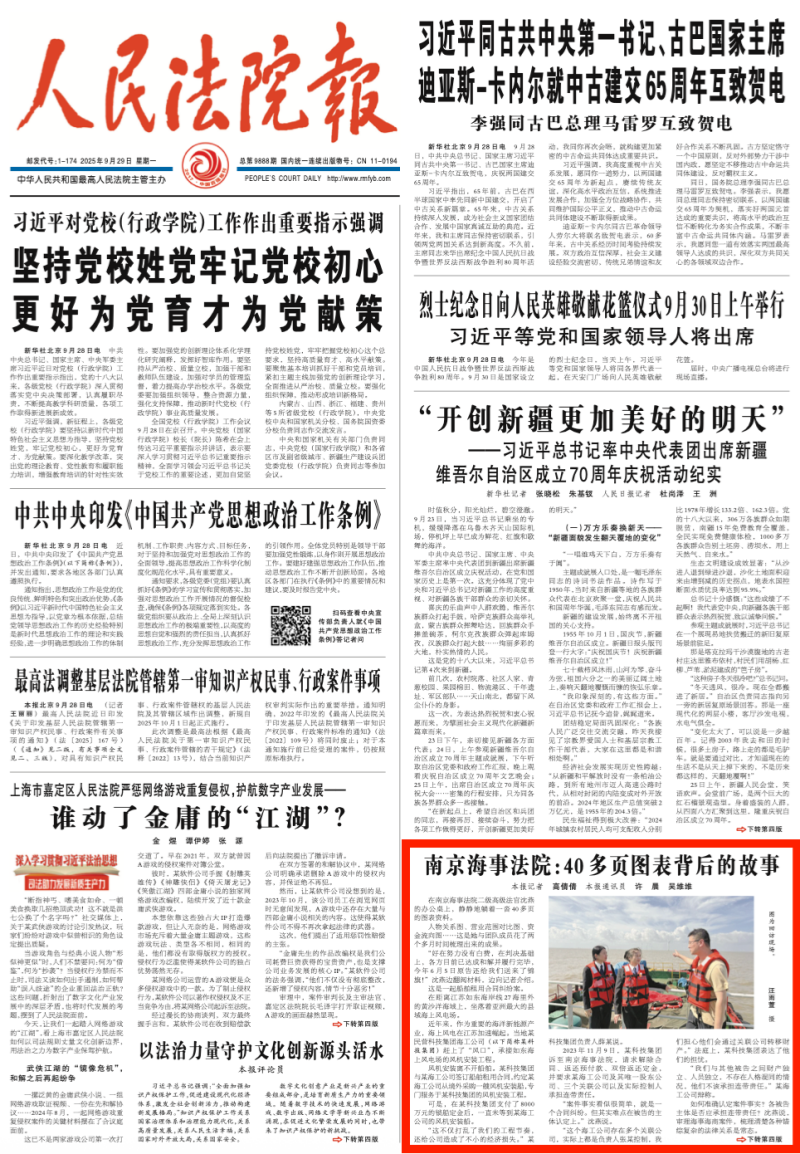
On the desk of Shen Yan, a Second-Grade Senior Judge at Nanjing Maritime Court, lies a stack of chart materials over forty pages thick.
Relationship diagrams, comparative charts of business scopes, fund flow charts... These represent the results of more than two months of meticulous analysis conducted by her and her team.
"Fortunately, the effort was not in vain. Based on the court's judgment, all parties have now reached a settlement and completed performance. On June 5 this year, the plaintiff even presented us with a commendatory banner!" Shen Yan explained to the reporter while reviewing the materials.
This case involves a dispute over a Vessel Charter Contract.
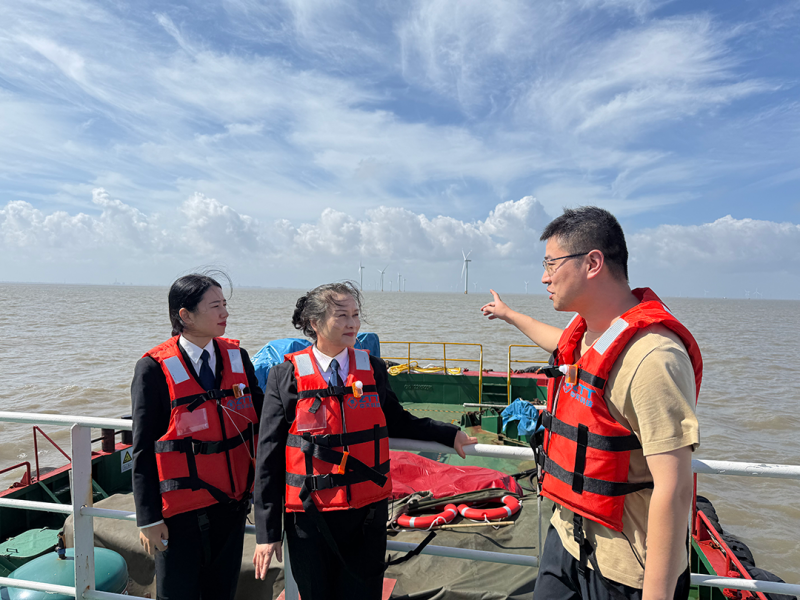
Located in the Huangshayang sea area, 27 nautical miles off the coast of Rudong, Jiangsu Province, sits Asia's largest county-level offshore wind farm.
In recent years, offshore wind power, as a significant new marine energy industry, has seen accelerated growth in Jiangsu. A local private technology group's offshore engineering company (hereinafter referred to as "the Tech Group") capitalized on this industry boom, securing the wind turbine installation project for the Rudong offshore wind farm.
Wind turbine installation is inseparable from specialized vessels. The Tech Group entered into a Vessel Charter Contract with an Offshore Engineering Company (hereinafter referred to as "Offshore Co."), stipulating that Offshore Co. would procure a Wind Turbine Installation Vessel from overseas to serve exclusively the Tech Group's installation project.
However, after the Tech Group paid an 80 million yuan vessel reservation deposit, the promised installation vessel from Offshore Co. never materialized.
"This not only disrupted our project timeline but also inflicted substantial economic losses on our company," said Mr. Xue, the responsible person of the Tech Group.
On November 9, 2023, the Tech Group filed a lawsuit with Nanjing Maritime Court, seeking to terminate the contract, recover the advance payment, obtain double the deposit pursuant to security rules, and demanding that Offshore Co., its sole shareholder company, three affiliated companies, and the actual controller bear joint and several liability.
"The factual background might appear straightforward—a simple contract dispute. But the true complexity lies in determining the liable defendants," Shen Yan stated.
"This offshore engineering company has multiple affiliated entities, all essentially controlled by the individual in charge, Mr. Zhang. We were concerned they might divert assets through these affiliated companies," the Tech Group expressed in court.
"Our assets, personnel, and operations are independent from the other defendants. There is no commingling of corporate personalities. They should not bear joint liability," argued Offshore Co.
How to accurately ascertain the case facts? Should the various defendant entities bear joint and several liability? Shen Yan remarked that untangling complex and intricate legal relationships is commonplace in adjudicating maritime and commercial cases.
Over the following two months, the case-handling team undertook extensive work:
Scrutinizing contract terms, verifying execution details, investigating the circumstances of the 80 million yuan payment; analyzing loan records and detailed fund transaction histories of the affiliated companies and related personnel over nearly a decade; ascertaining social insurance contribution status for directors, supervisors, and senior management of the defendant companies; reviewing the registered business scopes and operational addresses of multiple defendant companies...
To present the relationships among the defendants more clearly, the team created detailed charts including entity-relationship diagrams, business scope comparisons, and fund flow charts.
As the stack of charts grew taller, the facts of the case gradually came to light.
The court ascertained that the Vessel Charter Contract in question represented the genuine mutual intent of the parties and was legally valid. The Tech Group had paid the 80 million yuan vessel reservation deposit as agreed. Offshore Co.'s failure to deliver the vessel constituted a breach of contract, obligating it to return the advance payment and the deposit.
The defendant Offshore Co.'s parent company, acting as its sole shareholder, failed to prove the independence of its assets from Offshore Co. Three affiliated companies exhibited commingling of personnel and finances. Furthermore, the actual controller exercised excessive control and dominion over these affiliated companies, depriving Offshore Co. of its independent corporate existence. Therefore, Offshore Co., its parent company, the three affiliated companies, and the actual controller should all bear joint and several liability for the aforementioned debts in accordance with the law.
On December 31, 2024, Nanjing Maritime Court issued its judgment.
As Shen Yan indicated, maritime and commercial adjudication frequently encounters various intricate domestic and cross-border legal relationships. Therefore, what these 40-plus pages of charts represent extends beyond this single narrative.
As the only province in China endowed with major rivers, vast lakes, and an extensive coastline, Jiangsu possesses strategic advantages in deep-water ports and river-sea intermodal transport, alongside a strong offshore engineering equipment and marine vessel industry. The marine economy is flourishing here.
Offshore wind power represents the midstream manufacturing sector of the marine economy and epitomizes new marine productive forces. Since its establishment on December 4, 2019, Nanjing Maritime Court has duly adjudicated 903 disputes related to the offshore wind power industry chain, consistently safeguarding the marine economy's march toward innovation.
"Where the directives and deployments of the Central Committee and the Provincial Party Committee lead, maritime adjudication follows. Protecting the lawful rights and interests of private offshore engineering enterprises participating in offshore wind power development and construction according to law, and fostering the standardized and orderly development of offshore wind power, constitutes the inherent mission of maritime justice in escorting the high-quality development of the marine economy," said Li Yuming, Secretary of the Party Leadership Group and President of Nanjing Maritime Court.
On September 23, Shen Yan and her team conducted a follow-up visit to the Tech Group. Currently, the group's projects in new energy, communications, power, and other sectors are fully operational and expanding.
On the Huangshayang sea area, rows of white wind turbines stand like modern windmills against the ocean breeze, their massive blades, approximately 226 meters in diameter, rotating steadily. The fourteen characters on the commendatory banner presented by the parties—"Maritime Adjudication Upholds Impartiality, Safeguarding Private Enterprises Demonstrates Responsibility"—find a more tangible expression in this moment.