People's Court Daily Front Page Headline | 457 Days: "High-Tech Specialized Vessels" Sail into the Deep Blue
Today, People’s Court Dailypublished an article focusing on how Nanjing Maritime Court has continuously worked to resolve difficulties faced by shipbuilding enterprises under enforcement, supporting the growth of new marine productive forces through high-quality maritime judiciary services. The full text is reprinted below.
On the riverbank, a bustling shipyard lit up with welding sparks, accompanied by the clanging of steel and the roar of machinery. Not long ago, Judge Wang Hang of Nanjing Maritime Court once again stepped into Tongli Shipyard, located along the Yangtze River. Before him was a scene of vigorous production, with workers busy throughout the facility. Was this the same shipyard that, just the previous summer, had been struggling to survive amid disputes and on the verge of closure?
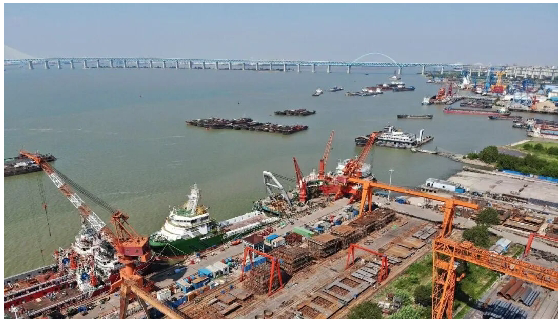
Right after the National Day holiday in 2024, Judge Wang Hang received a call: “Judge Wang, our engineering vessel is about to undergo sea trials—it can’t be auctioned! This ship was custom-built for a Singaporean shipowner, with a contract requiring delivery by November this year after trials. Any delay could trigger cross-border disputes, with penalties amounting to millions of yuan, not to mention subsequent compensation. Please help us!”
Tongli Shipyard’s precarious situation traces back to an application for vessel auction.
Imminent Delivery: Construction Challenges for an Engineering Vessel
Tongli Shipyard, established in 1997, is a long-standing private ship repair and builder in Nantong, Jiangsu. Starting as a small workshop, it gradually gained a foothold in specialized vessel repair and construction through dedicated innovation. Its engineered vessels and multi-functional workboats were highly sought after by domestic and international shipowners.
However, impacted by industry cyclical fluctuations, Tongli became entangled in disputes and was sued in Nanjing Maritime Court. In 2023, during the trial, the plaintiff applied for preservation measures to seize an under-construction vessel at Tongli.
In early January 2024, Judge Wang Hang traveled from Nanjing to Tongli Shipyard along the Yangtze’s Nantong section. At the seizure site, an under-construction vessel with a distinctive “top-heavy” design caught his attention: the wheelhouse and other heavy equipment were installed at the bow, while the stern was equipped with multi-purpose devices for maritime emergency rescue.
The shipyard director explained that this was a high-tech specialized “AHTS” (Anchor Handling, Tug, Supply) vessel, used in offshore oilfield development, wind power installation, emergency rescue, and major port operations, with an estimated market value of around RMB 120 million.
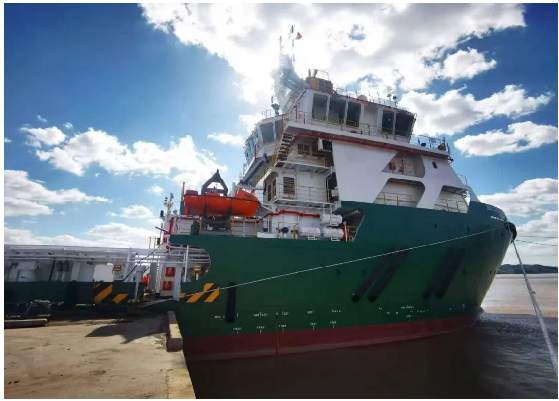
“This multi-purpose work vessel was impressive even under construction,”recalled Judge Wang Hang. To avoid delaying the build, the court arranged a “seizure without work stoppage,” allowing construction to continue under seizure.
After mediation, Tongli failed to fulfill its payment obligations. In May 2024, the applicant sought compulsory enforcement and applied for an auction of the vessel.
Judge Wang Hang recognized that a standard auction could lead to the customized vessel being scrapped—a great loss. He recalled the engineer’s pride in the ship’s dynamic positioning system, which allowed it to remain stable in open seas like a “sea-fixing needle.”
“Delivering such a vessel upholds not only international credibility but also the reputation of Chinese manufacturing!” Wang submitted the case for discussion by the court’s enforcement division.
“The debtor has indeed defaulted, but continuing construction shows efforts toward self-rescue,” Judge Wang reported.
“Tongli is part of the Nantong-Taizhou-Yangzhou marine equipment and high-tech vessel cluster, a national advanced manufacturing cluster. As enterprises advance from ‘manufacturing’ to ‘smart manufacturing,’ maritime justice must provide support. While the applicant’s rights must be realized, the shipyard must also be revived to fulfill overseas orders,” the judges agreed, setting a direction of promoting settlement and staged repayment.
After multiple negotiations, the applicant agreed to a “staged payment and release” plan, but disputes over the initial amount—RMB 200,000 versus RMB 50,000—led to a deadlock.
Hope for settlement eventually emerged when Shun Cang Ship Trading Company, a third-party partner, called: “We’ve invested heavily. If the vessel isn’t delivered, the Singaporean owner will initiate arbitration! We will file an enforcement objection.”
Though the call seemed to complicate matters, Judge Wang saw an opportunity: Could Shun Cang advance the initial settlement payment? After all, releasing the vessel was the only path to multi-party success.
Initially resistant due to risk, Shun Cang was persuaded by the enforcement team’s reasoning: “The priority is smooth delivery. Without resolving the debt, the vessel remains seized and faces auction, leading to greater losses and liability for breach of contract.” Shun Cang agreed to advance the payment.
By late October 2024, a settlement was signed. Shun Cang paid RMB 1 million to the applicant, who then applied for release. In November 2024, the vessel was successfully delivered to the Singaporean owner, sailing into the deep ocean.
Debt Crisis: Equipment Seizure and Another Challenge
Tongli’s troubles were not over. Taizhou Xing Tai Company, a long-term equipment supplier, sued Tongli over unpaid debts.
In November 2024, Xing Tai applied for enforcement, requesting seizure of another specialized vessel and shipbuilding equipment at Tongli.
The case was assigned to Judge Qian Jianguo.“This involves the same debtor, but the claim is twice the previous amount. The partner may lack further funds. If needed, we may have to seize and dispose of the shipyard’s equipment,”Judge Qian noted during a meeting.
“High-end shipbuilding equipment embodies R&D value and should not be hastily disposed of,”the judges concurred, deciding to investigate on-site.
At the site, Judge Qian’s team inventoried piping systems, electromechanical equipment, and posted seizure notices. Having discussed the prior case with Judge Wang, Qian knew the earlier settlement had enabled successful delivery.
“Another settlement ensuring vessel delivery would keep Tongli’s revival hopes alive—and ‘Made in China’ high-tech vessels sailing globally serve as living advertisements, boosting international orders,” Qian resolved to continue the “settlement relay.”
Noting idle shipways and equipment, Judge Qian saw an opportunity: Could a third party in need of shipbuilding space revitalize these assets?
Revitalizing Resources: International Orders Pour In
With trust from the prior case, Judge Qian’s “revitalization” idea won support from Tongli and Xing Tai. Tongli soon found a potential lessee—Nantong Shun Hang Company. Judge Qian facilitated tripartite talks.
“We want Shun Hang to pay rent directly to us and provide guarantee for Tongli’s debt, with staged repayment but tight timelines,” Xing Tai stated.
“We need funds for another AHTS vessel and request release before trials to avoid breach,” Tongli argued.
“We only want to lease the space, not get involved in disputes or provide guarantee,” Shun Hang insisted.
Despite differences, Judge Qian saw potential for agreement. “If rent is reduced and guarantee limited to rental obligations, could Shun Hang provide guarantee?” he proposed.
After several rounds, a deal was reached in over ten days: part of Tongli’s rent would be paid by Shun Hang directly to Xing Tai; Shun Hang and its representative would provide joint guarantee based on the lease; and Tongli could continue vessel construction.
On signing day, with no party willing to sign first, Judge Qian offered to witness the agreement. As“Witness: Qian Jianguo, Nanjing Maritime Court”was signed, concerns turned to trust.
Just 15 months after the first vessel faced auction, the second AHTS vessel underwent trials and delivery. As the settlement was performed, Xing Tai applied for pre-trial release, and Tongli proceeded with intensive delivery preparations.
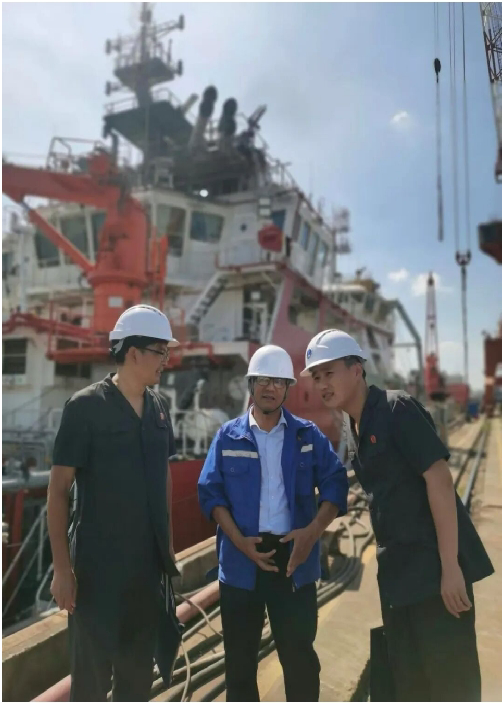
Meanwhile, leveraging Tongli’s facilities and 300+ skilled workers, lessee Shun Hang secured orders for six AHTS vessels, the highest priced at RMB 200 million.
From “scale leadership” to “technology leadership,” with judicial support, China’s high-tech specialized shipbuilding is sailing into the deep blue!
Judicial Support: Activating the “Deep Blue Engine” for Maritime Prosperity
President Xi Jinping has emphasized that advancing Chinese-style modernization requires high-quality development of the marine economy, charting a unique path toward maritime strength.
New marine productive forces, with high-tech specialized vessels as key carriers, form the sci-tech foundation for building a strong maritime nation. Such vessels involve long cycles, high costs, and strong international dimensions, making dispute resolution challenging. Nanjing Maritime Court’s innovative approaches offer a replicable model.
Upholding the Principle of Serving the Overall Situation. Global economic fluctuations impact high-tech vessel and marine equipment development. Courts must safeguard industrial chain stability. Nanjing Maritime Court’s efforts prevented “Chinese smart manufacturing” from being scrapped, revitalized hundreds of workers and resources, and made high-quality maritime enforcement a “deep blue engine” for new marine productive forces.
Adhering to the Concept of Good-Faith and Civilized Enforcement. Enforcement involves balancing multiple interests. The court employed “live seizures” (e.g., “seizure without work stoppage” for vessels, “lease in lieu of enforcement” for equipment), ensuring production continuity while realizing creditor rights.
Embodying the Spirit of Integrity and Innovation. Achieving legal and social effectiveness requires flexible, balanced measures. The court pioneered third-party advance payments for settlements to avoid breach of contract, and “debt guarantee + direct rent payment” to utilize assets. This demonstrates that enforcement is not passive “liquidation” but active “stage-setting,” turning crises into opportunities for multi-party wins.
Embodying the Spirit of Integrity and Innovation.(Note: This paragraph appears duplicated in the original; translation reflects the repetition.)
(All enterprise names in the article are pseudonyms.)