One Case from Nanjing Maritime Court Selected as a Typical Case of Waterborne "One-Stop" Dispute Resolution
On January 7, 2026, the Supreme People's Court held a press conference to release the Opinions of the General Office of the Supreme People's Court and the General Office of the Ministry of Transport on Promoting the Construction of Waterborne "One-Stop" Dispute Resolution Centers and typical cases of waterborne "One-Stop" dispute resolution. One case from Nanjing Maritime Court was selected.
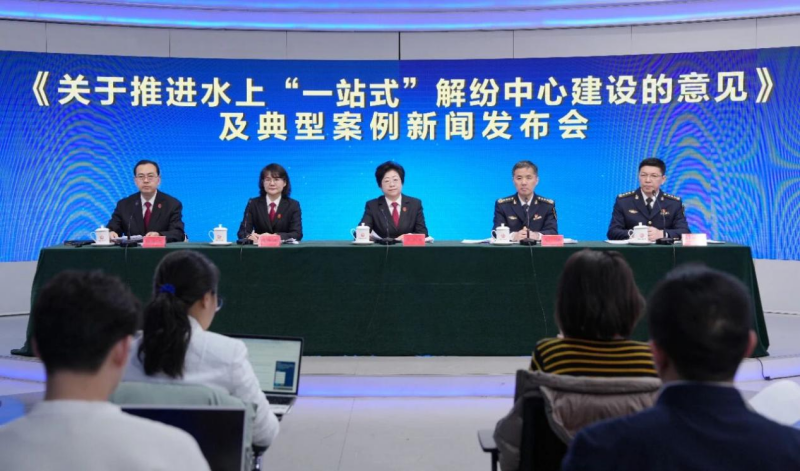
Typical Cases of Waterborne "One-Stop" Dispute Resolution
Table of Contents
Case 1: Nanjing Maritime Court Collaborates with Nanjing Maritime Safety Administration to Successfully Mediate a Foreign-Related Personal Injury and Death Dispute – Resolving a Foreign-Related Personal Injury and Death Dispute Using a Step-by-Step Mediation Approach
Case 2: Dalian Maritime Court Collaborates with Liaoning Maritime Safety Administration to Successfully Mediate a Foreign-Related Ship Collision Damage Liability Dispute – The "Maritime Court + Maritime Authority" Linkage Mechanism Efficiently Resolves a Major Foreign-Related Maritime Traffic Accident Dispute
Case 3: Qingdao Maritime Court Collaborates with Rizhao Maritime Safety Administration to Successfully Mediate a Maritime Personal Injury Liability Dispute – Government-Judiciary Coordination Resolves a Crew Member Fall Fatality Dispute at the Front End
Case 4: Ningbo Maritime Court Collaborates with Ningbo Maritime Safety Administration to Successfully Mediate a Ship Sale and Purchase Contract Dispute – Administrative + Judicial Synergy Implements the "Maritime Fengqiao Experience"
Case 5: Xiamen Maritime Safety Administration Collaborates with Xiamen Maritime Court to Successfully Mediate a Ship Collision Damage Liability Dispute – Maritime Expert Team Jointly with Maritime Judges Substantively Resolve a Major and Complex Ship Collision Dispute at Low Cost
Case 6: Guangzhou Maritime Safety Administration Jointly with Guangzhou Maritime Court Successfully Repatriates 8 Abandoned Foreign Crew Members – A Vivid Practice of the New Era "Maritime Fengqiao Experience"
Case 7: Dagukou Maritime Safety Administration Collaborates with Tianjin Maritime Court to Successfully Mediate a Labor Dispute Involving 12 Crew Members – Building an "Administrative + Judicial" Collaborative Model to Promote the Construction of a Pluralistic Dispute Resolution Cooperation Mechanism
Case 8: Yangpu Maritime Safety Administration Collaborates with Haikou Maritime Court to Successfully Mediate a Nearly Ten Million Yuan Crew Labor Dispute – A Successful Practice of the Governance Philosophy of "Using Cases to Promote Reform and Governance"
Case 1
Nanjing Maritime Court Collaborates with Nanjing Maritime Safety Administration to Successfully Mediate a Foreign-Related Personal Injury and Death Dispute
– Resolving a Foreign-Related Personal Injury and Death Dispute Using a Step-by-Step Mediation Approach
【Basic Facts】
On September 1, 2022, during cargo unloading operations of a foreign vessel at a certain terminal company, stevedores Wang and Ding entered the cargo hold for tallying work and lost consciousness, later succumbing to their injuries despite rescue efforts. Wang was an employee of Stevedoring Company A, and Ding was an employee of Stevedoring Company B. After the accident, the families of Wang and Ding demanded that the foreign shipping company, the terminal company, Stevedoring Company A, and Stevedoring Company B jointly assume liability for personal injury damages. This case was extremely complex: Firstly, it involved multiple parties, namely the terminal company, the shipowner, the stevedoring companies, and the families of the stevedores. Secondly, multiple legal relationships were intertwined, including labor contract relationships, mandate contract relationships, berth leasing, and stevedoring contract relationships. Thirdly, the cause of the accident was complex, potentially involving negligence either in the shipowner's cargo care or in the management of the stevedoring companies and the terminal company. If the dispute had proceeded directly to litigation, the foreign vessel would have faced the risk of arrest, and the lengthy litigation process would have delayed the payment of death compensation to the stevedores' families.
【Mediation Method and Result】
The "One-Stop" Dispute Resolution Center jointly established by Nanjing Maritime Court and Nanjing Maritime Safety Administration promptly intervened in the accident mediation. During the mediation process, it was found that the parties had significant disagreements regarding liability apportionment, making it extremely difficult to reach a comprehensive settlement agreement among all parties in the short term. Adhering to the principle of prioritizing the protection of vulnerable groups, the Dispute Resolution Center adopted a step-by-step mediation approach to soften conflicts. It prioritized ensuring that the stevedores' families received full compensation promptly by encouraging the stevedoring companies to sign One-Time Work-Related Injury Compensation Agreements with the deceased's families, ensuring timely and full payment. This effectively ensured the families received adequate compensation within a relatively short period and helped stabilize their emotional state. After compensation by the stevedoring companies, for the portion not covered by work-related injury insurance and commercial insurance compensation, the terminal company, which had stronger financial capacity, was persuaded to make an advance payment. Within one month of the accident, the Dispute Resolution Center swiftly organized the shipowner, terminal company, and stevedoring companies to reach a Payment of Compensation and Provision of Letter of Guarantee Agreement. It was agreed that the shipowner would provide a guarantee letter from a certain insurance company, undertaking to pay the finally determined compensation. This allowed the foreign vessel to depart smoothly, effectively safeguarding the shipowner's anticipated income. After handling the urgent situation, the Dispute Resolution Center organized mediation among the shipowner, terminal company, and stevedoring companies regarding the internal apportionment of liability. After multiple rounds of negotiations, the parties reached a final mediation agreement.
【Typical Significance】
Personal injury and death liability disputes in maritime and navigable waters are a category of disputes where conflicts are particularly acute in practice. They concern the vital interests of vulnerable groups such as crew members, fishermen, and dockworkers, and require prompt and proper resolution. Guided by the circumstances, the Dispute Resolution Center adopted a step-by-step mediation method, placing the protection of dockworkers' rights and interests first. It temporarily set aside the issue of liability apportionment among the multiple liable parties, treating them as a collective entity to first compensate the dockworkers for their full losses externally, before determining the internal liability ratios. Simultaneously, it resolved the conflict between the potentially lengthy dispute resolution process and the foreign vessel's need to depart for operations by using a letter of guarantee. This effectively mitigated confrontation among the liable parties and laid a good foundation for communication towards the final resolution. The successful mediation of this case provides guidance for resolving complex foreign-related maritime personal injury and death liability disputes and has been praised by both Chinese and foreign parties involved.