Li Yuming Delivers a Lecture on “Adjudication Methods for Cases in Which the Facts to Be Proved Remain Uncertain”
On November 5, Li Yuming, President of the Court, delivered a lecture to all judges and staff on “Adjudication Methods for Cases in Which the Facts to Be Proved Remain Uncertain.”
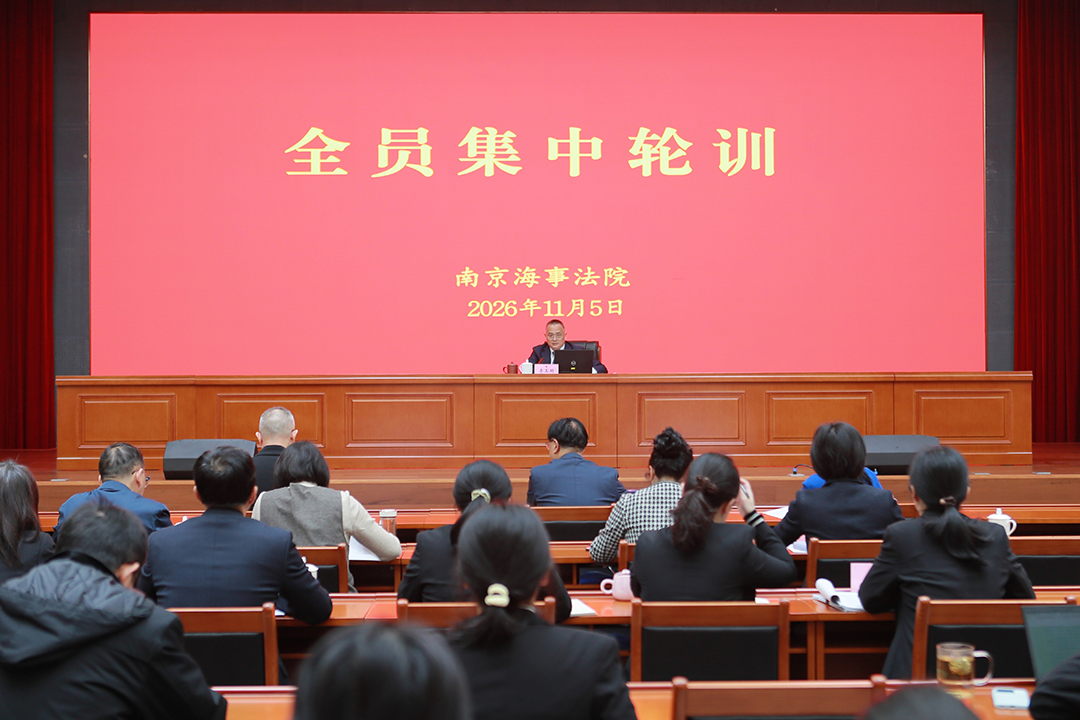
Drawing on practical judicial experience, Li Yuming explained relevant legal concepts such as the allocation of litigation risks, the burden of proof in civil litigation, and standards of proof. He noted that adjudicating maritime cases in which the facts to be proved remain uncertain is a complex systematic undertaking that requires the organic integration of legal rules, evidentiary standards, and adjudicative reasoning. He summarized adjudication methods for such cases in seven areas: dynamic allocation of the burden of proof; technology-based authentication of electronic evidence; substantive determination of the validity of “unknown clauses”; quantitative application of the principle of good faith; internationalization of adjudicative reasoning; emphasis on integrating technology and law; and establishment of correct judicial philosophy and value orientation.
Li Yuming held that in handling such cases, judges must adhere to the adjudicative philosophy of giving priority to legal truth while treating objective truth as a supplement, strictly follow a progressive adjudicative reasoning process, use the allocation of the burden of proof on ultimate facts as the fundamental statutory basis, flexibly apply tiered standards of proof, and rely on chains of circumstantial evidence together with rules of experience to overcome evidence gaps. At the same time, they should dispel parties’ reasonable doubts through a full and transparent exposition of the court’s reasoning on the evidence. In the adjudication process, judges must strictly respect the limits of the law, avoid adjudicative pitfalls such as abuse of judicial discretion, mechanical application of evidentiary rules, and disregard for customary trade practices, adopt adjudication methods appropriate to the type of case, and unify adjudication standards for similar cases.